American pharmaceutical giant Pfizer has agreed to merge with Irish drug company Allergan. Even though Pfizer is a considerably larger company, under the conditions of the deal Allergan will technically be the "buyer." The reason? Corporate inversion! A fancy term for legal tax evasion. See, because Pfizer will suddenly, officially, become an "Irish" company--despite the fact that the bulk of Allergan's business, like Pfizer's, is actually conducted in the United States--Pfizer will be subject to Irish corporate tax rates, which are considerably lower than those of the US. Conservatives will no doubt shriek that this just proves that American taxes are too high, driving venerable corporations like Pfizer to such extremes of financial gamesmanship. One wonders how much American governmental largesse has found its way into Pfizer's research and development coffers--to say nothing of protections offered by American patent laws and other governmental services that Pfizer is now seeking not to have to pay for. But never mind that.
As much as one's gorge rises at Pfizer's behavior, there is a silver lining: I think this suggests a solution to the Syrian refugee crisis. I'm thinking that, if American families take in refugees, the Americans could declare that the refugees are actually "sheltering" them--and that they--the Americans--should therefore be subject to tax rates of the refugees' original homes. I frankly have no idea what Syria's federal tax rate is, but even if it's considerably higher than the US', I don't see Bashar al-Assad coming over to collect.
Of course it's a ridiculous proposal: Ludicrous tax dodges are only for multi-billion dollar companies seeking exorbitant profit, not for people displaying exorbitant generosity.
Showing posts with label Business. Show all posts
Showing posts with label Business. Show all posts
Tuesday, November 24, 2015

Sunday, November 1, 2015
In Which We Call Attention to the Fine Print
The other day, I received an unexpected check from Chase Bank for $6.70. The timing was perfect, since, as it happens, I was exactly $6.70 over my monthly budget. Were it not for this windfall, I would have lost everything--home, car, ability to buy food. . . . I would at the very least have had to forego my venti pumpkin spice until payday. I kissed the check on the lips and vowed never again to put myself in such a precarious situation.
And good thing, too, because the class action lawsuit--the source of the above-mentioned corporate largesse--is becoming a thing of the past. Today, more and more businesses, from banks and credit card companies to restaurants and adultery facilitation websites, slip disclaimers into the fine print of service contracts essentially barring consumers from filing class-action lawsuits. Instead, potential customers must agree to resolve any disputes through binding arbitration--a fact these customers often discover only after suffering injury and seeking legal redress.
In principle, there is nothing wrong with arbitration--it can be an efficient way to settle disputes. Problems arise, however, when the amounts at stake are too small to make it worthwhile for individuals to pursue arbitration on their own behalf. Take my check, for example. (Please don't literally take my check: Starvation! Pumpkin spice withdrawal!) I confess, I have no idea what this check was for: Presumably, Chase engaged in some shenanigans--shocking, I know!--and injured me and any number of other people to the tune of a few dollars each. Now, even if I knew what Chase had done to me, and even if the actual financial harm done me was several times greater than $6.70--$25, $50, heck, maybe even $100--would I really go to the time (potentially months) and expense (potentially thousands of dollars), to try to recoup the money? Not unless I was a fanatic or an idiot.
Yeah, shut up.
The point is, while class action suits result in relatively trivial victories for individual consumers, they also serve to punish and, ideally, deter corporate malfeasance. My tiny check is just a fraction of what must have been a multi-million dollar settlement against Chase. And maybe the memory of that settlement will dissuade Chase from. . . well, doing whatever they did to merit that punishment. We can hope.
What is particularly noxious about these "pro-arbitration" (really just anti-class action) clauses is the arrogance of companies in thinking they could impose them in the first place. What these clauses say, in so many words, is "We reserve the right to do whatever we want--legal or not--and we further declare that you can't do anything about it." And the Supreme Court, because Scalia, somehow has no problem with this: "The antitrust laws do not guarantee an affordable procedural path to the vindication of every claim." Or, as Elena Kagan wrote in her dissent, when consumers feel they have been wronged by arbitration clauses, the judicial response is, "Too darn bad."
So what can consumers do? Not a whole lot. Many of these fine-print contracts allow consumers to opt out of the arbitration clause, but consumers usually have a limited time in which to assert this right--and, of course, finding that provision requires the consumer to read through the whole eye-straining document. Stories tell of one man--I think he lives somewhere in Minnesota--who managed to read through the entire Apple service agreement--but these tales are probably apocryphal. No such man could truly exist. Consumers can also, of course, opt not to patronize businesses that require arbitration, but with more and more companies employing this tactic, alternatives are limited, to say the least.
In the meantime, I'm debating whether to cash my check or just frame it. It may turn out to be a historical artifact of inordinate worth. A relic of a time when consumers had some small power against corporate overlords.
And good thing, too, because the class action lawsuit--the source of the above-mentioned corporate largesse--is becoming a thing of the past. Today, more and more businesses, from banks and credit card companies to restaurants and adultery facilitation websites, slip disclaimers into the fine print of service contracts essentially barring consumers from filing class-action lawsuits. Instead, potential customers must agree to resolve any disputes through binding arbitration--a fact these customers often discover only after suffering injury and seeking legal redress.
In principle, there is nothing wrong with arbitration--it can be an efficient way to settle disputes. Problems arise, however, when the amounts at stake are too small to make it worthwhile for individuals to pursue arbitration on their own behalf. Take my check, for example. (Please don't literally take my check: Starvation! Pumpkin spice withdrawal!) I confess, I have no idea what this check was for: Presumably, Chase engaged in some shenanigans--shocking, I know!--and injured me and any number of other people to the tune of a few dollars each. Now, even if I knew what Chase had done to me, and even if the actual financial harm done me was several times greater than $6.70--$25, $50, heck, maybe even $100--would I really go to the time (potentially months) and expense (potentially thousands of dollars), to try to recoup the money? Not unless I was a fanatic or an idiot.
Yeah, shut up.
The point is, while class action suits result in relatively trivial victories for individual consumers, they also serve to punish and, ideally, deter corporate malfeasance. My tiny check is just a fraction of what must have been a multi-million dollar settlement against Chase. And maybe the memory of that settlement will dissuade Chase from. . . well, doing whatever they did to merit that punishment. We can hope.
What is particularly noxious about these "pro-arbitration" (really just anti-class action) clauses is the arrogance of companies in thinking they could impose them in the first place. What these clauses say, in so many words, is "We reserve the right to do whatever we want--legal or not--and we further declare that you can't do anything about it." And the Supreme Court, because Scalia, somehow has no problem with this: "The antitrust laws do not guarantee an affordable procedural path to the vindication of every claim." Or, as Elena Kagan wrote in her dissent, when consumers feel they have been wronged by arbitration clauses, the judicial response is, "Too darn bad."
So what can consumers do? Not a whole lot. Many of these fine-print contracts allow consumers to opt out of the arbitration clause, but consumers usually have a limited time in which to assert this right--and, of course, finding that provision requires the consumer to read through the whole eye-straining document. Stories tell of one man--I think he lives somewhere in Minnesota--who managed to read through the entire Apple service agreement--but these tales are probably apocryphal. No such man could truly exist. Consumers can also, of course, opt not to patronize businesses that require arbitration, but with more and more companies employing this tactic, alternatives are limited, to say the least.
In the meantime, I'm debating whether to cash my check or just frame it. It may turn out to be a historical artifact of inordinate worth. A relic of a time when consumers had some small power against corporate overlords.
Sunday, August 18, 2013
Blowing Smoke
Sometimes I read the paper and get the feeling that I'm supposed to be outraged or indignant, and yet I just can't get myself all worked up. So it was today upon reading a front-page article about how cigar manufacturers entice the young and impressionable (i.e., the stupid) by peddling tobacco products in a variety of flavors that would make Bertie Botts proud (just google it). Grape cigars! Cherry cigars! Chocolate cigars! If my stepfather--a true cigar aficionado--were alive today, he'd be rolling over in his grave at such sacrilege--or at the very least yuckiness.
The point of the article, though, was that cigar manufacturers were finding ways to sidestep federal laws against marketing tobacco products to minors by selling Wonka-esque cigarillos, which are not subject to congressional regulation. The FDA has discretion to regulate such products, and the agency has promised to introduce new rules, but as yet no such rules have been promulgated. And frankly, I just don't care.
As a lifelong non-smoker, I have no love for the tobacco industry. I would certainly discourage people from smoking. At the same time, I just think the government has more important things to do than pass ever more laws protecting people from their own self-destructive behaviors. By this time, everybody knows smoking will kill you. If people choose to do it anyway, isn't that their business? Why does the government need to get involved?
Laws against smoking in public places make sense: They protect the innocent bystander from the toxic effects of other people's personal behavior. But it seems to me at best hypocritical for the government to say, on the one hand, that a product is perfectly legal, but, on the other hand, that the makers of this product cannot attempt to sell it to the broadest clientele possible. And after all, if you own a business, and the product you sell reliably kills a large portion of your customers, then you need to do all the marketing you can. That's just the American way!
The point of the article, though, was that cigar manufacturers were finding ways to sidestep federal laws against marketing tobacco products to minors by selling Wonka-esque cigarillos, which are not subject to congressional regulation. The FDA has discretion to regulate such products, and the agency has promised to introduce new rules, but as yet no such rules have been promulgated. And frankly, I just don't care.
As a lifelong non-smoker, I have no love for the tobacco industry. I would certainly discourage people from smoking. At the same time, I just think the government has more important things to do than pass ever more laws protecting people from their own self-destructive behaviors. By this time, everybody knows smoking will kill you. If people choose to do it anyway, isn't that their business? Why does the government need to get involved?
Laws against smoking in public places make sense: They protect the innocent bystander from the toxic effects of other people's personal behavior. But it seems to me at best hypocritical for the government to say, on the one hand, that a product is perfectly legal, but, on the other hand, that the makers of this product cannot attempt to sell it to the broadest clientele possible. And after all, if you own a business, and the product you sell reliably kills a large portion of your customers, then you need to do all the marketing you can. That's just the American way!
Saturday, August 17, 2013
The Company? They Keep..
Traditionally, Japanese businesses--particularly large corporations--do not lay people off. Japanese culture prizes loyalty--what I believe in Japanese is called, wasabi--over pure profit. In practice, though, this means that workers who in a normal economy (America) would be laid off may instead find themselves relegated to "chasing-out" rooms (Japanese: teriyaki), purgatorial chambers where the unproductive must while away their days reading, doing crosswords--which are really hard, 'cause, y'know, they're in Japanese--or maybe just napping, all while shamefully collecting their full unearned salaries It all sounds. . . .
Well, frankly, it sounds awesome. As a teacher who missed out on the opportunity to be relegated to one of New York City's infamous "Rubber Rooms"--a sort of "holding pen" where unfirable teachers facing disciplinary action would while away the days while their cases meandered through the system--I would love to be hired and not laid off by Sony or Toyota. Do you suppose they need any feckless English teachers?
In all seriousness--well, most seriousness, anyway--this is a problematic situation: Japanese businesses claim that their inability to lay off older or less productive workers makes them unable or unwilling to hire new employees. Unable because their personnel budgets are stretched to support unnecessary workers; unwilling because they don't want to find themselves stuck years from now with another batch of workers in need of "chasing-out." The complaints make a certain amount of sense. Personally, though, I hope that when these companies ultimately settle on a plan of action to address this issue, they retain some of the traditional values--loyalty, concern for the general welfare--that enabled them to thrive in the first place.
Well, frankly, it sounds awesome. As a teacher who missed out on the opportunity to be relegated to one of New York City's infamous "Rubber Rooms"--a sort of "holding pen" where unfirable teachers facing disciplinary action would while away the days while their cases meandered through the system--I would love to be hired and not laid off by Sony or Toyota. Do you suppose they need any feckless English teachers?
In all seriousness--well, most seriousness, anyway--this is a problematic situation: Japanese businesses claim that their inability to lay off older or less productive workers makes them unable or unwilling to hire new employees. Unable because their personnel budgets are stretched to support unnecessary workers; unwilling because they don't want to find themselves stuck years from now with another batch of workers in need of "chasing-out." The complaints make a certain amount of sense. Personally, though, I hope that when these companies ultimately settle on a plan of action to address this issue, they retain some of the traditional values--loyalty, concern for the general welfare--that enabled them to thrive in the first place.
Thursday, June 27, 2013
Great Moments in Branding
The Ford Motor Company has announced that it will soon offer a new light truck that will be " the first-ever EcoBoost®-powered sport truck"--whatever that means. The truck will go on sale this fall and it will be named. . . the Tremor.
Keep an eye out for a related story, in which the Ford Motor Company lays off its director of marketing--or whoever thought it a great idea to name a truck after a symptom of Parkinson's Disease. What names did they reject? The Ford Rigidity? The Ford Incontinence? The Ford Bradykinesia? (Look it up!) This undoubtedly marks the worst instance of vehicle branding since General Motors started naming its luxury fleet after major figures of the Third Reich. I've been trying to unload my Chrysler Ribbentrop for years!
Keep an eye out for a related story, in which the Ford Motor Company lays off its director of marketing--or whoever thought it a great idea to name a truck after a symptom of Parkinson's Disease. What names did they reject? The Ford Rigidity? The Ford Incontinence? The Ford Bradykinesia? (Look it up!) This undoubtedly marks the worst instance of vehicle branding since General Motors started naming its luxury fleet after major figures of the Third Reich. I've been trying to unload my Chrysler Ribbentrop for years!
Friday, November 16, 2012
Twinkie the Kid Shrugged
See what happens when you elect Democrats? For over seventy-five years, Twinkies have expanded the waistlines and decayed the teeth of sugar-addicts the world over. Along with cockroaches, Twinkies were presumed capable of surviving a nuclear apocalypse! But they couldn't survive the prospect of a second Obama term. Not one week after the President's re-election, the apparently emboldened Twinkie-making proletariat at Hostess Brands went on strike. Unwilling to meet the workers' radical demands--presumably including frills like living wages and decent working conditions--Hostess today announced a suspension of operations. The Twinkie, my friends, is dead!
It's not like we weren't warned. The job creators told us what would happen if we re-elected Obama. We all yawned when Papa John's CEO threatened to raise the price of pizza and/or reduce his workforce--mainly because we wouldn't eat his crappy pizza if he paid us. But now, with the bigwigs at Hostess going all John Galt on us, well. . . shit just got real!
Laugh all you want, but I have seen what the future has in store. At my college's bookstore, you know what's being sold as "snacks"? Pickles! Individually wrapped pickles floating in pouches filled with some kind of gelatinous brine! Suddenly Ho-Ho's don't sound so disgusting anymore, do they?
OK, maybe they do. I'll admit, Twinkies vs. gelatinous pouch-pickles is something of a Sophie's Choice. But at least it WAS a choice. We've gone from Sophie's to Hobson's! The creeping socialism feared by so many encroaches ever-so-much further on our beloved American freedoms! Today Twinkies, tomorrow freedom to assemble! Or, y'know, maybe Go-gurt, who knows?
It's not like we weren't warned. The job creators told us what would happen if we re-elected Obama. We all yawned when Papa John's CEO threatened to raise the price of pizza and/or reduce his workforce--mainly because we wouldn't eat his crappy pizza if he paid us. But now, with the bigwigs at Hostess going all John Galt on us, well. . . shit just got real!
Laugh all you want, but I have seen what the future has in store. At my college's bookstore, you know what's being sold as "snacks"? Pickles! Individually wrapped pickles floating in pouches filled with some kind of gelatinous brine! Suddenly Ho-Ho's don't sound so disgusting anymore, do they?
OK, maybe they do. I'll admit, Twinkies vs. gelatinous pouch-pickles is something of a Sophie's Choice. But at least it WAS a choice. We've gone from Sophie's to Hobson's! The creeping socialism feared by so many encroaches ever-so-much further on our beloved American freedoms! Today Twinkies, tomorrow freedom to assemble! Or, y'know, maybe Go-gurt, who knows?
Saturday, November 10, 2012
It's On
Have you heard about the "job creators" who, in a fit of toddler-esque spite, are laying off workers in the wake of President Obama's re-election. Ostensibly. they can "no longer afford" these workers due to the onerous taxes that the Obama administration has not actually imposed, to say nothing of the mandates of the Affordable Care Act. Papa John's CEO John Schnatter, for example, ominously warned that, once Obamacare is enacted, customers may have to pay up to 14 cents more for a pizza. . . .
I'm sorry, that doesn't quite capture things:
UP TO 14 CENTS MORE PER PIZZA!!!!!
There, that's better.
Anyway, Schnatter has now said he will reduce workers' hours so as to avoid having to provide them with health insurance (a requirement that kicks in when employees work more than 30 hours a week). To put it another way, Schnatter will charge you more for pizza AND force you to pay for his employees' health care when they show up at emergency rooms and/or sign up for taxpayer-sponsored insurance policies.
Mr. Schnatter, I personally have no problem paying an extra 14 cents for pizza if it means people get healthcare. In fact, I'm willing to pay up to--oh, I don't know, an extra 28 cents! Maybe even 43! But guess what? I--and I suspect many other like-minded folks--will not spend a DIME on your pizza if this is your attitude toward the public good.
By the way, to whatever audience I have: Please pass along any information about companies that are responding with similar petulance to the thought of having to, y'know, contribute to society. Not so much to ME--rather to Facebook and any other outlets that have a wider reach. If these folks don't like the cost of doing business, let's try to make sure they have considerably less business to do.
I'm sorry, that doesn't quite capture things:
UP TO 14 CENTS MORE PER PIZZA!!!!!
There, that's better.
Anyway, Schnatter has now said he will reduce workers' hours so as to avoid having to provide them with health insurance (a requirement that kicks in when employees work more than 30 hours a week). To put it another way, Schnatter will charge you more for pizza AND force you to pay for his employees' health care when they show up at emergency rooms and/or sign up for taxpayer-sponsored insurance policies.
Mr. Schnatter, I personally have no problem paying an extra 14 cents for pizza if it means people get healthcare. In fact, I'm willing to pay up to--oh, I don't know, an extra 28 cents! Maybe even 43! But guess what? I--and I suspect many other like-minded folks--will not spend a DIME on your pizza if this is your attitude toward the public good.
By the way, to whatever audience I have: Please pass along any information about companies that are responding with similar petulance to the thought of having to, y'know, contribute to society. Not so much to ME--rather to Facebook and any other outlets that have a wider reach. If these folks don't like the cost of doing business, let's try to make sure they have considerably less business to do.
Thursday, August 9, 2012
Thursday Trendwatch
10. AGENT ORANGE: Why it's trending: The United States has begun a large clean-up project at a former US military base in central Vietnam, where the land has been contaminated by dioxin, a chemical component of the infamous defoliant. Meanwhile, back at Solipsist Central, we have an orange cat that WOS refuses to let me name "Agent." Or "Dioxin."
9. RHEUMATOID ARTHRITIS: Why it's trending: A comparative study of "biologic" drugs used to treat rheumatoid arthritis has found no significant difference in the risk of death faced by users of three common medications: Humira, Remicade, and Flerpelzam. (I may have gotten that last name wrong.) That's the good news. The bad news is that the risk of death for all three drugs hovers around 92%.
8. BABY BELUGA DIES: Why it's trending: I'm not sure I want to know! OK, in the interest of fulfilling my solemn obligation to report the news to you, my loyal followers, I will LOOK at the article. I'm just hoping that "Baby Beluga" is the nickname of some Ukrainian wrestler. . . .
Well, turns out "Baby Beluga" wasn't a wrestler. She was a whale named Kavna, but she wasn't actually a baby: She died in Vancouver at what I can only assume is, for a whale, the ripe old age of 46. Kavna inspired the noted children's songwriter Raffi, who is not annoying at all, to write the hit song "Baby Beluga," which topped the heavy-metal charts for ninety-three weeks back in the 1980s.
7. HONEY BOO BOO CHILD: Why it's trending: Can't wait to check this out.
OK.
Well, Alana "Honey Boo Boo" Thompson was the, God help us, "breakout star" of TLC's "Toddlers in Tiaras." The six-year-old gained a measure of fame for such exploits (good word choice, that) as prancing around a stage in "'Daisy Dukes' and cut-off shirts." She was so. . .somehow the word "successful" seems wrong. . . well, whatever she was, it was enough to prompt TLC to create a whole series around the adventures of Honey Boo Boo and her family: Mom June, Dad "Sugar Bear," and sisters "Pumpkin," "Chubbs" and "Chickadee." No, I'm not making this up.
Sometimes, I think the terrorists might be right.
6. JOAN RIVERS: Why she's trending: Apparently, because she's Honey Boo Boo Child--or, at any rate, that's where the link took me. Go figure.
5. DISH NETWORK: Why it's trending: DISH network reported a nearly 33% decrease in earnings compared to the same period last year. As far as I can tell, this news qualifies DISH as one of the most successful companies in America.
4. KERRI WALSH JENNINGS: Why she's trending: She and Misty Mae Treanor just won gold at the Olympics:
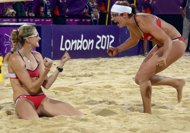
Apparently, these ladies were participating in some sort of sport. Who knew? (I mean, sure, neither one of them is Honey Boo Boo Child, but still! Sorry.)
3. JOAN RIVERS: Why she's trending: Ah, here it is. The comedienne handcuffed herself to a shopping cart at Costco as a protest against the retailer's refusal to carry her latest book. Keeping things in proper perspective, she stated of Costco's actions, "This is the beginning of Nazi Germany."
First they came for the elderly female stand-up comics, and I said nothing, for I was not an elderly female stand-up comic. . . .
At her next protest, Rivers plans to chain herself to something that cannot simply be wheeled away.
2. POWERBALL JACKPOT: Why it's trending: The Powerball jackpot has climbed to over $250 million! I am so relieved that nobody won yesterday: See, yesterday, for the first time in, like, ten years, I forgot to buy a lottery ticket! I'd hate to think I missed out on the jackpot. Anyway, this Saturday, I'll play the numbers I always play: 3, 7, 11, 15, and 28, with a Powerball number of 12.
Hey, WOS, what were yesterday's winning numbers, anyway? Wait, why are you hiding the newspaper . . .
!!!!!!
AAAAAAAAAAAAAAAAAAAAAAAAAAAAAAAAAARRRRRRRRRRRRRRRRRRR--
1. ANN CURRY: Why she's trending: Oh who the fuck cares?!?!? Look it up yourself!
Where was I? Oh, yeah:
AAAAAAAAAAAAAAAAAAAAAAAAAAAAAAAAAAAAAAAAAAAARRRRRRRRRRRRRRRRRRRRRRRRRRRRRGGGGGGGGGGGGGGGGGGGGGGGGGGGGHHHHHHHHHHHHHHHHHHHH!!!!!!
9. RHEUMATOID ARTHRITIS: Why it's trending: A comparative study of "biologic" drugs used to treat rheumatoid arthritis has found no significant difference in the risk of death faced by users of three common medications: Humira, Remicade, and Flerpelzam. (I may have gotten that last name wrong.) That's the good news. The bad news is that the risk of death for all three drugs hovers around 92%.
8. BABY BELUGA DIES: Why it's trending: I'm not sure I want to know! OK, in the interest of fulfilling my solemn obligation to report the news to you, my loyal followers, I will LOOK at the article. I'm just hoping that "Baby Beluga" is the nickname of some Ukrainian wrestler. . . .
Well, turns out "Baby Beluga" wasn't a wrestler. She was a whale named Kavna, but she wasn't actually a baby: She died in Vancouver at what I can only assume is, for a whale, the ripe old age of 46. Kavna inspired the noted children's songwriter Raffi, who is not annoying at all, to write the hit song "Baby Beluga," which topped the heavy-metal charts for ninety-three weeks back in the 1980s.
7. HONEY BOO BOO CHILD: Why it's trending: Can't wait to check this out.
OK.
Well, Alana "Honey Boo Boo" Thompson was the, God help us, "breakout star" of TLC's "Toddlers in Tiaras." The six-year-old gained a measure of fame for such exploits (good word choice, that) as prancing around a stage in "'Daisy Dukes' and cut-off shirts." She was so. . .somehow the word "successful" seems wrong. . . well, whatever she was, it was enough to prompt TLC to create a whole series around the adventures of Honey Boo Boo and her family: Mom June, Dad "Sugar Bear," and sisters "Pumpkin," "Chubbs" and "Chickadee." No, I'm not making this up.
Sometimes, I think the terrorists might be right.
6. JOAN RIVERS: Why she's trending: Apparently, because she's Honey Boo Boo Child--or, at any rate, that's where the link took me. Go figure.
5. DISH NETWORK: Why it's trending: DISH network reported a nearly 33% decrease in earnings compared to the same period last year. As far as I can tell, this news qualifies DISH as one of the most successful companies in America.
4. KERRI WALSH JENNINGS: Why she's trending: She and Misty Mae Treanor just won gold at the Olympics:
Apparently, these ladies were participating in some sort of sport. Who knew? (I mean, sure, neither one of them is Honey Boo Boo Child, but still! Sorry.)
3. JOAN RIVERS: Why she's trending: Ah, here it is. The comedienne handcuffed herself to a shopping cart at Costco as a protest against the retailer's refusal to carry her latest book. Keeping things in proper perspective, she stated of Costco's actions, "This is the beginning of Nazi Germany."
First they came for the elderly female stand-up comics, and I said nothing, for I was not an elderly female stand-up comic. . . .
At her next protest, Rivers plans to chain herself to something that cannot simply be wheeled away.
2. POWERBALL JACKPOT: Why it's trending: The Powerball jackpot has climbed to over $250 million! I am so relieved that nobody won yesterday: See, yesterday, for the first time in, like, ten years, I forgot to buy a lottery ticket! I'd hate to think I missed out on the jackpot. Anyway, this Saturday, I'll play the numbers I always play: 3, 7, 11, 15, and 28, with a Powerball number of 12.
Hey, WOS, what were yesterday's winning numbers, anyway? Wait, why are you hiding the newspaper . . .
!!!!!!
AAAAAAAAAAAAAAAAAAAAAAAAAAAAAAAAAARRRRRRRRRRRRRRRRRRR--
1. ANN CURRY: Why she's trending: Oh who the fuck cares?!?!? Look it up yourself!
Where was I? Oh, yeah:
AAAAAAAAAAAAAAAAAAAAAAAAAAAAAAAAAAAAAAAAAAAARRRRRRRRRRRRRRRRRRRRRRRRRRRRRGGGGGGGGGGGGGGGGGGGGGGGGGGGGHHHHHHHHHHHHHHHHHHHH!!!!!!
Tuesday, December 20, 2011
Fun with Lawsuits
"At the heart of the disputes are the kind of small but convenient features that would cause many people to complain if they were not in their smartphones. For example, the case decided Monday involves the technology that lets you tap your finger once on the touch screen to call a phone number that is written inside an e-mail or text message. It also involves the technology that allows you to schedule a calendar appointment, again with a single tap of the finger, for a date mentioned in an e-mail."In response to the ruling, makers of android phones have promised to alter the technology so that it requires one and one half finger-taps. Meanwhile, in a countersuit, android manufacturers are suing Apple over the appearance of the word "android" in online dictionaries included as free apps for iPhones. Washington is also suing Apple over the company's use without permission of the state's iconic fruit as both its corporate name and, by implication, as the nickname of downloadable features. The Seattle tribe of Native Americans is in turn suing Washington State, but, as usual, no one is paying any attention.
--"U.S. Backs Apple in Patent Ruling That Hits Google"
Meanwhile, back in the mobile-phone-and-app arena, a group of ornithologists is suing Zynga for defamation on behalf of birds everywhere, who insist they are not angry, merely anti-pig. Last year, the National Association of Pig Farmers settled with Zynga for an undisclosed amount. The Solipsist will file a suit against Google next week for its continuous snubbing of this column as a "Blog of Note."
The Arab League is also suing mobile phone manufacturers for their unlicensed use of the numerals 1 through 9 on keypads.
Sunday, December 11, 2011
The 24/7 Rat Race
Today's Times featured a front-page story about high-flying traders--you know, the type who destroyed the world economy a few years back--who get up in the wee small hours of the morning to get a jump on the day's trading: They don't want to sleep through the opening bells in the euro zone, you see. I imagine some of these folks probably alter their sleep cycles to keep pace with markets in Asia.
Does it make me a bad person that I take some satisfaction in knowing that the sleep debt these guys--and they are mostly guys--rack up will probably lead to a great deal of personal suffering and, perhaps, premature death?
Turn off your Bloomberg terminals! Go to sleep! Maybe you'll dream of a way to do something productive with your lives!
Does it make me a bad person that I take some satisfaction in knowing that the sleep debt these guys--and they are mostly guys--rack up will probably lead to a great deal of personal suffering and, perhaps, premature death?
Turn off your Bloomberg terminals! Go to sleep! Maybe you'll dream of a way to do something productive with your lives!
Tuesday, November 29, 2011
The Cost of Doing Business
Among the financial shenanihoots that helped bring down the world financial system was a scheme by Citigroup to sell investments that were designed to fail so that the company could bet against them and reap huge profits. The Securities and Exchange Commission took a dim view of this and filed suit against Citigroup. The two parties agreed to settle the lawsuit: Citigroup would pay a $285 million fine, without admitting to any wrongdoing. All that was left was for Federal Judge Jed S. Rakoff to sign off on the deal. Yesterday, however, Judge Rakoff rejected this agreement.
Good for him.
The agreement bothered Judge Rakoff because he was asked, essentially, to serve as a "rubber stamp." Despite the fact that the SEC alleged that Citigroup had committed fraud, the agreement provided insufficient specifics, and the company was not required to admit wrongdoing. Therefore, the judge could not determine whether the agreement was “fair, reasonable, adequate and in the public interest." And about that whole, "Is it in the public interest" question? Let me save you some trouble, Judge Rakoff: It's not.
The judge correctly pointed out that, while $285 million may sound like a lot of money, it's basically pocket change to a company like Citigroup. And paying such a fine--particularly if a settlement does not require a company to admit wrongdoing--can be written off as an acceptable cost of doing business. The SEC wants to settle the cases because the agency worries--understandably--that it cannot win a trial against a company with the vast legal and financial resources of Citigroup. A bird in the hand--or 285 million birds--is worth some even more hefty amount in the bush.
Except it's not.
If the government took Citigroup--or AIG or Bank of America or any of the other malefactors of great wealth--to trial, nobody knows what would happen. The government might very well lose the case. I suspect, though, they might not. And at any rate, going to trial would send a message that the costs of doing business might turn out higher than Citigroup might like to pay. Obviously, these petty-cash fines don't convince the wrongdoers to change their evil ways.
So Judge Jed Rakoff did his job. Now it's time for the SEC to do theirs.
Good for him.
The agreement bothered Judge Rakoff because he was asked, essentially, to serve as a "rubber stamp." Despite the fact that the SEC alleged that Citigroup had committed fraud, the agreement provided insufficient specifics, and the company was not required to admit wrongdoing. Therefore, the judge could not determine whether the agreement was “fair, reasonable, adequate and in the public interest." And about that whole, "Is it in the public interest" question? Let me save you some trouble, Judge Rakoff: It's not.
The judge correctly pointed out that, while $285 million may sound like a lot of money, it's basically pocket change to a company like Citigroup. And paying such a fine--particularly if a settlement does not require a company to admit wrongdoing--can be written off as an acceptable cost of doing business. The SEC wants to settle the cases because the agency worries--understandably--that it cannot win a trial against a company with the vast legal and financial resources of Citigroup. A bird in the hand--or 285 million birds--is worth some even more hefty amount in the bush.
Except it's not.
If the government took Citigroup--or AIG or Bank of America or any of the other malefactors of great wealth--to trial, nobody knows what would happen. The government might very well lose the case. I suspect, though, they might not. And at any rate, going to trial would send a message that the costs of doing business might turn out higher than Citigroup might like to pay. Obviously, these petty-cash fines don't convince the wrongdoers to change their evil ways.
So Judge Jed Rakoff did his job. Now it's time for the SEC to do theirs.
Monday, October 17, 2011
Great Moments in Common Sense
I am aghast. According to a front-page article in today's Times:
Just how reasonable is this? Consider the fact that, while the Obama Administration was in favor of it, so was the largest trade group of wireless carriers, whose president, Steve Largent, is a former NFL player (back when the Seahawks were an NFL team) and Republican congressman, who is about as true-believing a right-winger as there is! If THESE two groups can agree on something, then. . . . Well, actually, then there must be something wrong with the rule. Let's see. . . .
Ah, here we go: Now, if people go over their allotted minutes, their phones will send massive electric shocks into their groinal areas. OK. I feel much better now.
"Users of cellphones and other wireless devices who are nearing their monthly limit for voice, text or data services will receive alerts when they are in danger of being charged extra, under an agreement reached by carriers and the Federal Communications Commission."This blew my mind: a simple, common-sense solution to a somewhat pervasive problem: unexpected and exorbitant cellphone charges. Wow: A governmental regulation that costs corporations very little while at the same time offering some basic protections to the average consumer.
Just how reasonable is this? Consider the fact that, while the Obama Administration was in favor of it, so was the largest trade group of wireless carriers, whose president, Steve Largent, is a former NFL player (back when the Seahawks were an NFL team) and Republican congressman, who is about as true-believing a right-winger as there is! If THESE two groups can agree on something, then. . . . Well, actually, then there must be something wrong with the rule. Let's see. . . .
Ah, here we go: Now, if people go over their allotted minutes, their phones will send massive electric shocks into their groinal areas. OK. I feel much better now.
Tuesday, March 29, 2011
New! Improved! Shrunken!
An interesting article today reports that food manufacturers are disguising price increases by subtly reducing the size of their wares while charging the same price. Even more insidious, some companies actually charge more for the diminished offerings, claiming that the "new" product is "lower in calories." Be on the lookout for scams: Wrigley's single-stick gum bookmarks: $1.89 New and Improved extra-puffy Cheetos: Twice the AIR!: $4.59/lb. Extra LOW-CAL bottled water: $3.89/liter Special NON-METRIC extra LOW-CAL bottled water: $3.99/qt M&M ULTRA: Each candy stamped with TWO 'm's: $9.99 lb. Ol' Doc Simmons' Caffeine Free Oxygen: $99.99 a tank Solipsistography "Food Inflation Kept Hidden in Tinier Bags"
Thursday, February 10, 2011
Frankfurt Stock Exchange Bids to Buy "Big Board": American Financiers, Academics Finally Admit They Don't Understand Any of This Either

A SOLIPSIST EXCLUSIVE--German investors revealed that they are in negotiations to purchase the venerable New York Stock Exchange. Meanwhile, American stock traders, financial management professionals, bankers, and others finally admitted that they have absolutely no idea what any of this means.
"I can't tell you how many times I've been asked to explain the stock market in 'layman's terms,'" Goldman Sachs Chief Executive Lloyd Blankfein said. "I usually just start throwing around words like 'supply' and 'demand' and then I draw some graphs on envelopes. Awhile back, some folks started to suspect that I was just making things up--that's when we came up with the expression 'back-of-the-envelope' calculation to make what I was doing sound better."
When asked to comment on the Frankfurt Stock Exchange's proposed purchase of the NYSE, Treasury Secretary Tim Geithner said, "What?"
He continued, "Wait, how does someone buy a stock exchange? I mean, it's not, like, a thing. It's a place, right? I mean, it's not a place. . . you could buy a place. . . but. . . ." Mr. Geithner then patted his pants pocket and claimed that he had to "take this call. Seriously, it's on vibrate!It could be the President." He then ran out of the room.
Dr. Percy Duffman, Professor of Finance at MIT, explained that the entire concept of "stocks" was originally "a joke made up by a group of itinerant pipe salesmen who used to gather under a blueberry tree on what would later become Wall Street. They made up all kinds of words: 'stocks,' 'bonds,' 'debentures,' 'throodles,' 'ortivestules'--of course, not all of these words caught on. The fact is, they were really just putting letters together and making up definitions to go with them.
"One day, the local constabulary came to roust them, and they convinced him that if he bought some of their 'stocks,' they could guarantee him a good return on his. . . . Well, that was when one of them coined the word 'investment,' and the rest is history."
Details on the proposed purchase have yet to be revealed, but it is rumored that Frankfurt Stock Exchange executives are offering in excess of 18 billion throodles for the NYSE.
Solipsistography
Friday, January 28, 2011
More Undeserved Bailouts

Take heart, Nation! Your faith in humanity is not misplaced. Consider the case of Gil Meche.
Meche is a mediocre Major League pitcher. Some years back, the Kansas City Royals inexplicably decided to lavish a major portion of their extremely limited payroll (the Yankees they ain't) to sign Meche as a free agent. They signed him to a guaranteed five-year, $55 million contract before the 2007 season, despite his frankly unspectacular record with the Seattle Mariners. After some injury-plagued seasons, Meche announced the other day that he would retire, rather than collect the $12 million due him this season. Because realistically he could not pitch at anywhere close to peak performance, Meche felt it would be wrong to accept the exorbitant salary that the Royals would have been obligated to pay him--particularly since the team had already paid him more than $40 million over the last four years.
Mr. Meche, your self-respect is exemplary. This act of civility and, frankly, generosity takes our breath away, and we can think of only one appropriate response:
What are you, a moron?!?
It must be nice to have the luxury to walk away from $12 million, but, still, IT'S TWELVE MILLION DOLLARS!!! When the Royals offered you this contract, they showed the kind of sound business judgment we've come to associate with Lehman Brothers, but that's hardly your fault. They were prepared to pay you; they were obligated to pay you. If you would have felt bad about accepting "undeserved" money, you could have donated your paychecks to charity.
All you've done is let a baseball team--a big business even if it is the Royals--off the hook for what turned out to be a calamitous financial decision. It's one thing for the government to bail out spendthrift corporations. Why should the employees have to bear the brunt?
Solipsistography
Tuesday, January 18, 2011
Jobs Flees Apple Amid Growing Unrest--A Solipsist Exclusive

SAN FRANCISCO--Citing "health" issues, Steve Jobs, President-for-Life of Appleland, fled corporate headquarters yesterday. His destination is unclear, although he is rumored to have been granted asylum in neighboring Googlevania. Jobs' prime-minister, Timothy Cook, has assumed control of the government, in what outraged protesters are calling an unconstitutional power grab.
Jobs has struggled to project an air of business-as-usual despite increasing protests about his authoritarian style and seeming indifference to the plight of his subjects. The anti-Jobs movement began late last year, after Woody McFarland of Columbus, Ohio, set himself on fire outside a local Apple store. McFarland was driven to his desperate act by frustration with the poor iPhone service he received from AT&T. Since then, dissident mobs have marched regularly on Apple headquarters, wearing "What Would Woody Want" t-shirts and frequently burning iPhones in effigy and themselves in not-effigy.
In an attempt to pacify protesters, Jobs announced that Apple would begin offering iPhone service on Verizon. While the announcement was welcomed, spokesmen for the Rotten Apple Party claimed the action was "too little too late."
"Jobs and his cronies have held us hostage for too long," said opposition leader Bill "No Relation" Gates. "Yes, Apple products are cool. But why do we have to buy an iPhone and an iPad? Shouldn't we at least get a discount? And why doesn't the iPad have a camera?"
RAP is demanding that Cook hold free and fair elections within the next six months. "We will continue to set ourselves on fire until our demands are met."
Analysts speculate that, if its customers continue to self-immolate, Appleland can survive for two more years at most. The United Nations will debate sending in peacekeepers at a special emergency session later this week.
Solipsistography:
Monday, January 3, 2011
Judgment Day
In the "Terminator" movies, computers become sentient and declare war on humanity. Since the machines control all of mankind's weapon systems, including nuclear weapons, their victory is swift.
We fear we may be on the verge of our own sort of "Judgment Day." We don't worry so much about the increasing intelligence of computers as we do about the lack of intelligence--or at least foresight--of their programmers. And we worry less about a nuclear holocaust than we do about a sort of financial armageddon that could have the same civilization-destroying capacity.
If you needed any more proof that the entire financial industry is (ahem) a solipsistic enterprise that ultimately produces nothing other than more grist for its own mills, consider the advent of "High Frequency Trading." In HFT, computer algorithms allow traders to execute trades within millionths of seconds. By taking advantage of the slightest--and we mean slightest--head start, traders can exploit fractional differences in stock prices and make fast profits.
If we understand this phenomenon correctly, it works like this: Computers programmed to scan the markets for--well, for whatever: We don't know what programmers base their algorithms on--identify a stock and execute a "buy" order. Let's say that the price is $100.0001. The computer makes the purchase, and then the stock may "skyrocket" to $100.0002 (perhaps in response to the very purchases the automated trader just made). Other (ever-so-slightly) slower autotraders notice the movement and begin making their own purchases. By now, the stock may have shot up to, oh, $100.0004. So it's time for the first trader to sell! Sure, we're dealing with fractions of a penny, but if you consider the fact that tens of thousands of trades can be executed every minute, the profits can accumulate quickly.
Note that profit and loss seem to have absolutely nothing to do with the inherent worth of any sort of product or business. The only commodity of value in HFT is speed--microseconds of speed. If a programmer sets up an algorithm to make purchases of a company specializing in snail-poop, he can presumably attract the notice of enough other high-frequency traders to turn a tidy profit before these other investors realize they're buying crap. And if autotraders misread market signals, they can provoke a panic that can quickly send the broader market crashing (as happened last spring).
(We realize our explanation is probably extremely simplistic. If anyone can offer a more thorough explanation of HFT--and ideally explain HOW it adds any real value to the world--please feel free to do so in the "Comments.")
What can be done? Probably not much. It does make one wish that these traders--indeed, most of the high-flying financiers who make money for nothing while playing video games with other people's actual savings--could simply be sealed off in their own sector of society. They could then safely play their games and we could watch (or not) while we go about the real business of the world.
Solipsistic References:
"The New Speed of Money, Reshaping Markets"
If you're among the few people on the planet who haven't seen "Terminator 2," you should: It was from James Cameron's pre-"Titanic" days when he just made really cool science-fiction movies.
We fear we may be on the verge of our own sort of "Judgment Day." We don't worry so much about the increasing intelligence of computers as we do about the lack of intelligence--or at least foresight--of their programmers. And we worry less about a nuclear holocaust than we do about a sort of financial armageddon that could have the same civilization-destroying capacity.
If you needed any more proof that the entire financial industry is (ahem) a solipsistic enterprise that ultimately produces nothing other than more grist for its own mills, consider the advent of "High Frequency Trading." In HFT, computer algorithms allow traders to execute trades within millionths of seconds. By taking advantage of the slightest--and we mean slightest--head start, traders can exploit fractional differences in stock prices and make fast profits.
If we understand this phenomenon correctly, it works like this: Computers programmed to scan the markets for--well, for whatever: We don't know what programmers base their algorithms on--identify a stock and execute a "buy" order. Let's say that the price is $100.0001. The computer makes the purchase, and then the stock may "skyrocket" to $100.0002 (perhaps in response to the very purchases the automated trader just made). Other (ever-so-slightly) slower autotraders notice the movement and begin making their own purchases. By now, the stock may have shot up to, oh, $100.0004. So it's time for the first trader to sell! Sure, we're dealing with fractions of a penny, but if you consider the fact that tens of thousands of trades can be executed every minute, the profits can accumulate quickly.
Note that profit and loss seem to have absolutely nothing to do with the inherent worth of any sort of product or business. The only commodity of value in HFT is speed--microseconds of speed. If a programmer sets up an algorithm to make purchases of a company specializing in snail-poop, he can presumably attract the notice of enough other high-frequency traders to turn a tidy profit before these other investors realize they're buying crap. And if autotraders misread market signals, they can provoke a panic that can quickly send the broader market crashing (as happened last spring).
(We realize our explanation is probably extremely simplistic. If anyone can offer a more thorough explanation of HFT--and ideally explain HOW it adds any real value to the world--please feel free to do so in the "Comments.")
What can be done? Probably not much. It does make one wish that these traders--indeed, most of the high-flying financiers who make money for nothing while playing video games with other people's actual savings--could simply be sealed off in their own sector of society. They could then safely play their games and we could watch (or not) while we go about the real business of the world.
Solipsistic References:
"The New Speed of Money, Reshaping Markets"
If you're among the few people on the planet who haven't seen "Terminator 2," you should: It was from James Cameron's pre-"Titanic" days when he just made really cool science-fiction movies.
Friday, December 24, 2010
Word of the Day: Humanitarian
As in "Humanitarian aid," the kind of goods and services that United States companies are permitted to sell to nations that the American government otherwise sanctions (e.g., Iran, North Korea, Solipsist Headquarters ((long story))). Allowable products include such things as grains and rice to stave off starvation, as well as medicines and, presumably, some medical supplies and equipment. Oh, and, um, what else?
"[A]llowable humanitarian aid has included cigarettes, Wrigley’s gum, Louisiana hot sauce, weight-loss remedies, body-building supplements and sports rehabilitation equipment sold to the institute that trains Iran’s Olympic athletes."
Remember those tobacco manufacturers who testified before Congress that cigarettes were not harmful? Apparently, they were telling the truth! Not only are cigarettes not harmful, they're medicine! Or maybe food.
Not to worry, though: The licensing office that approves humanitarian exemptions allowing manufacturers to ship to blacklisted countries is on the case:
Not to worry, though: The licensing office that approves humanitarian exemptions allowing manufacturers to ship to blacklisted countries is on the case:
"Take, for instance, chewing gum, sold in a number of blacklisted countries by Mars Inc., which owns Wrigley’s. 'We debated that one for a month. Was it food? Did it have nutritional value? We concluded it did,' Hal Eren, a former senior sanctions adviser at the licensing office, recalled before pausing and conceding, 'We were probably rolled on that issue by outside forces.'”
Well, OK, what do you expect from government bureaucrats? But, look, ask the manufacturers. THEY can explain the vital role their products play in the health and well-being of innocent populations whose only crime is living under oppressive regimes:
"Henry Lapidos, export manager for the American Pop Corn Company, acknowledged that calling the Jolly Time popcorn he sold in Sudan and Iran a humanitarian good was 'pushing the envelope,' though he did give it a try. 'It depends on how you look at it — popcorn has fibers, which are helpful to the digestive system,' he explained, before switching to a different tack. 'What’s the harm?' he asked, adding that he didn’t think Iranian soldiers 'would be taking microwavable popcorn' to war."
 Weapon of mallow destruction?
And if they do, we can always hope that the little kernels getting stuck between their teeth distract them long enough for our boys to finish 'em off.
(Image from Jollytime.com)Monday, August 24, 2009
Money for Nothing
The other day we alluded to the fact that we have little interest in the world of high finance. We should amend that: We have an interest in everything. What we have for high-finance falls more neatly under the heading of contempt. We were reminded of this today when we read an article dealing with the phenomenon of "high-frequency trading" ("Arrest Over Software Illuminates Wall St. Secret").
Now, be advised, the Solipsist is no Master of the Universe, so he could be woefully misinformed about everything he's ranting about here. Bear with us.
Our basic understanding is that the stock market works something like this: A company sells shares of itself to the public. The price of these shares moves up or down based on how well or how poorly investors think the company is doing or will do. So, let's say shares of Solipsist, Inc. (SPSI), cost $20.00. If The Wall Street Journal announces that our humble blog is about to be bought out by, say, CNN, the price will probably shoot up--maybe to $25.00 a share. If, on the other hand, SPSI was bought out by some shaky or shady outfit like Enron or General Motors, our stock would move in a downward direction. This much we can understand.
Things get strange when stock movements become self-perpetuating--basically all the time. In this phenomenon, one person decides that a stock is extremely desirable (or undesirable) and buys (sells) many shares. Someone else sees this person buying shares and decides he, too, must get in on the action. But because the first person has bought so many shares, the price of remaining shares has gone up. Which, of course, makes the first person happy because he has just made a (paper) profit, but the second person is in a slightly less enviable position--though not as unenviable as the third, fourth, fifth--and so on--investors, who will pay ever greater sums for this ever-more desirable stock. But the whole movement started with one person who, for all we know, knows nothing about the stock's inherent value. This is what is known as a "bubble."
Now, "high-frequency trading" really sleazes things up. As far as we understand, HFT works like this: A bunch of computer geeks devise algorithms to enable computers (often independent of people) to spot very small movements in stock prices. These computers then execute very high-volume trades in very rapid succession--far faster than any human trader could. To illustrate, a program may execute a purchase of 10,000 shares of Widgets, Inc., at a dollar each and then, within fractions of seconds, when the price goes up to $1.01, sell those shares and make a quick $100 profit. Not much in absolute terms, but when you consider that these algorithms allow firms to execute hundreds or thousands of such trades at a time, you realize we're talking about a lot of money.
Traders argue that this improves efficiency, but it sounds kind of sketchy. After all, wouldn't the very act of buying so many shares so quickly cause the price to rise and thereby virtually guarantee a profit for the algorithm-user, irrespective of anything like the actual value of the stock in question? And, if other traders pick up on the apparent "volatility" of the stock, might they not flee the company in panic--even though the volatility is completely artificial?
The Solipsist is no communist (although socialism looks better and better every day). But isn't this kind of pointless, non-productive capitalism-for-the-sake-of-capitalism exactly the kind of thing Marx was talking about when he called for the workers of the world to unite? Can anyone defend this kind of pointless greed?
Subscribe to:
Posts (Atom)